Writer & Video Essayist
What is this, a blog?
August 1, 2026
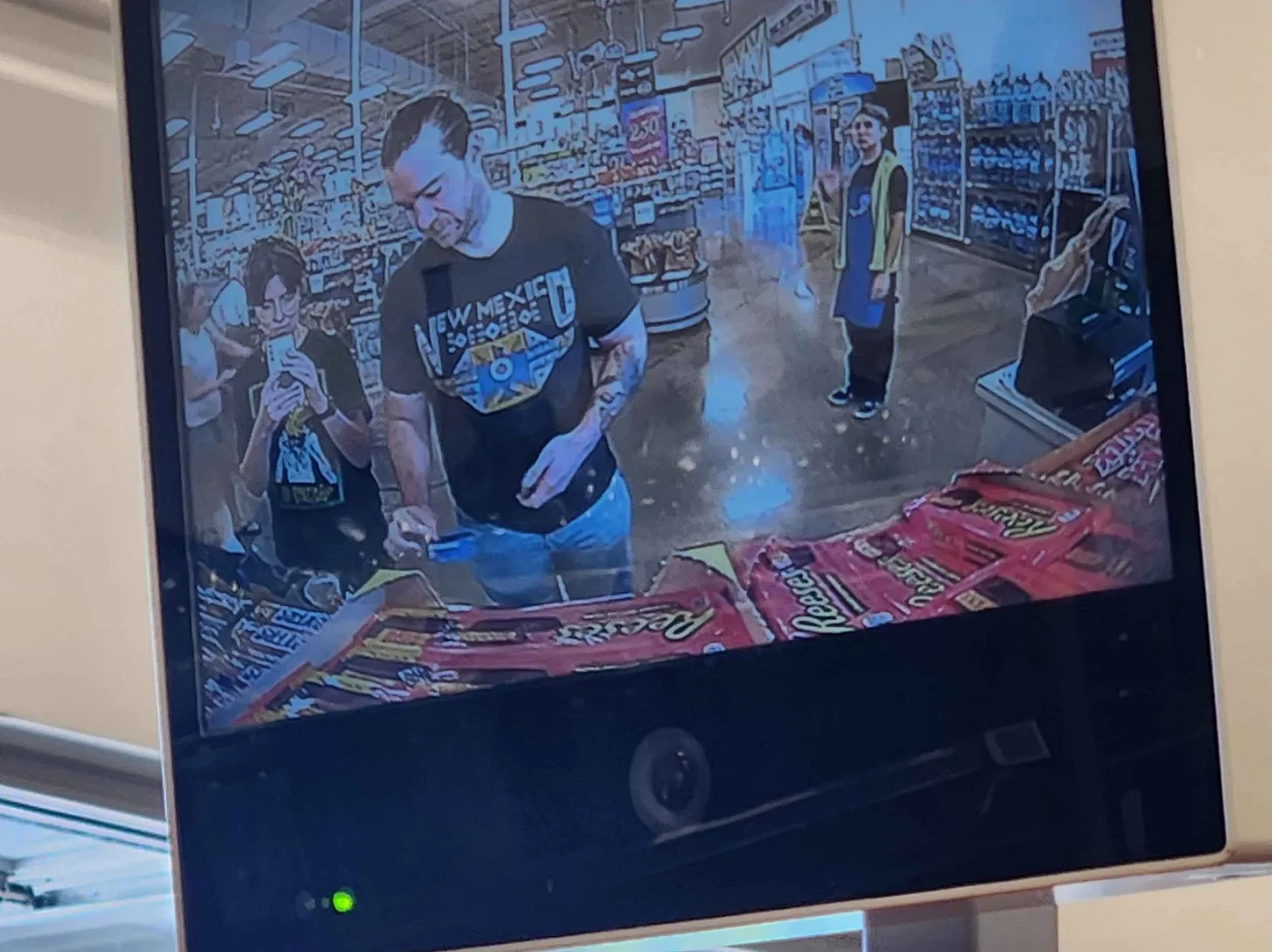
Hello again, friends new and old. Here’s what I’ve been up to lately:
- ICYMI, I put out a new video essay in June. It’s about American visual culture—where it’s been (derogatory) and where it’s going (vaguely ominous). Check it out on YouTube if you haven’t yet.
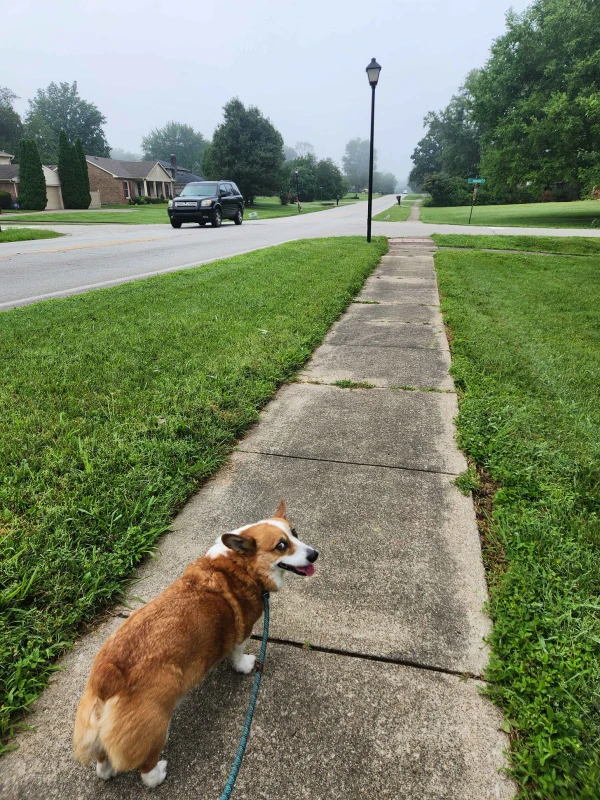
- I really enjoyed making this one. In fact, focusing solely on longform videos has been so fruitful that I’m considering hanging up my TikTok spurs for good. Which begs the question, what is this newsletter for, if not to keep y’all abreast of my short videos? Should I just yap about the mundane facts of my life? Should I post my pinball high scores? Should I share photos of weeds growing up through the sidewalk cracks? What is this, a blog?
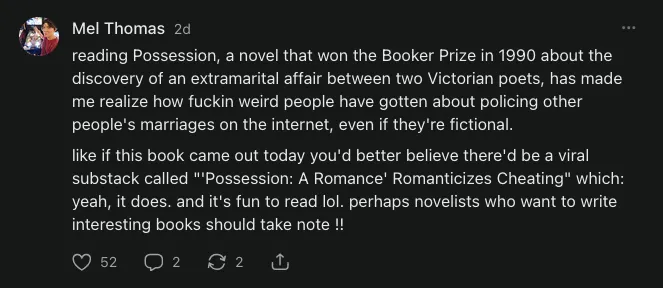
- I’m reading A.S. Byatt’s Possession. It’s about two scholars who discover that the poets they respectively study had a secret, extramarital affair with each other. Every page of this book equals roughly one (1) bite of chocolate torte. Delicious and dense.
- This is a novel about the information we shed as we live our lives: often innocuous and occasionally incriminating. Who does it belong to? If I were writing a contemporary retelling of Possession, I’d call it The Right to Cheat on Your Spouse in a Surveillance State.
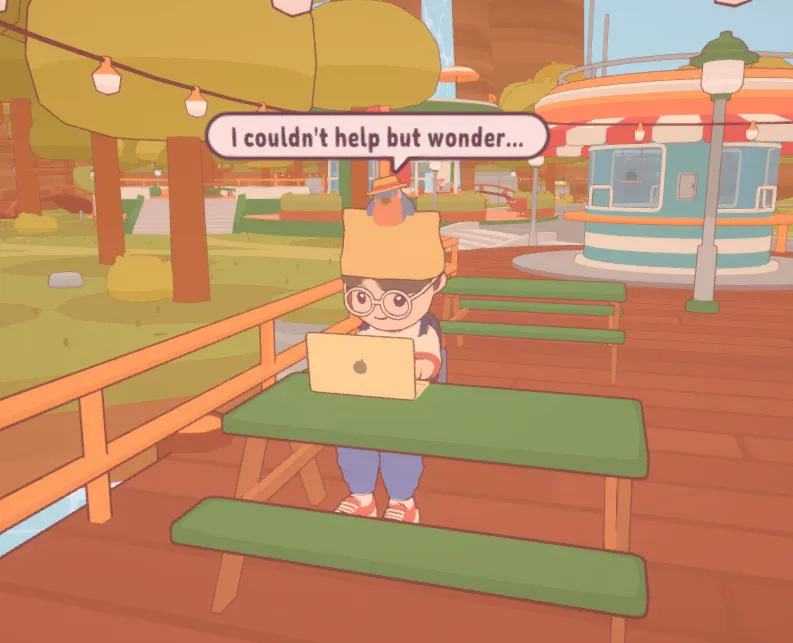
- Last month I logged over 60 hours in a virtual co-working game called On-Together. My friend Kevin got me hooked on it. If you’re getting WeWork flashbacks from that description, I don’t blame you, but I promise it’s Not Like That.
- On-Together is a digital body doubling game. People describe it as “cozy,” if that means anything to you. You join a server, enter “focus mode,” and proceed with your regular daily tasks, feeling motivated to stay on track because you’re Being Perceived by other people. These other people are, like you, represented by highly customizable avatars, who in turn have their own highly customizable pets. It’s all very, even aggressively, cute.
- It’s shocking how much I’ve begun to look forward to playing this game (almost) every day. But then again, why shouldn’t I? If the ping of Slack can induce real world dread, why can’t chilling with my homies on a digital oceanfront instill a bit of real world serenity?
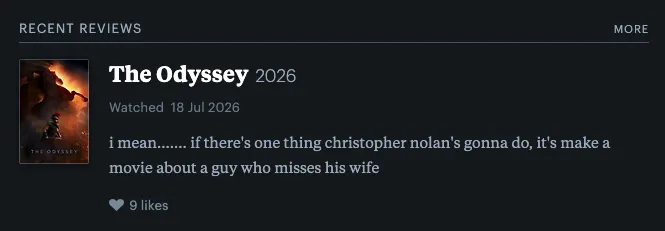
- I’ve been going to the CINEMA. I’ve watched both Backrooms and The Odyssey since my last update, and I’m pleased to report that practical effects are so back. And look, I didn’t love either of them, but I did love the experience of watching them in honest-to-God, speaker-rattling, hydrogenated soybean oil-drenched movie theaters.
- Remember in 2020 when they said that movie theaters were dead? Ha!
- Speaking of The Odyssey, I’m slowly making my way through Walter J. Ong’s Orality and Literacy, first published in 1982. In it, Ong frequently cites both The Iliad and The Odyssey as a bridge between contemporary literary cultures and ancient oral ones.
- In the wake of Nolan’s adaptation, The Odyssey has been subject to a lot of concern trolling from the sorts of people who’d like to be able to look back on Ancient Greece as both origin-and-pinnacle of Western literacy. The trouble is, of course, that Homeric Greeks couldn’t read. In fact, The Odyssey, containing the myriad earmarks of oral storytelling, wouldn’t exist if they could have.
- My personal Sopranos summer continues! God, what a show. I talk about it in this month’s Patreon bonus video.
- I added some new media recommendations to my Neocities site. Books, essays, fanfic—pick your poison.
- I read Do Androids Dream of Electric Sheep? by Philip K. Dick.
- Maybe the most significant difference between the book and its (arguably?) more famous adaptation, Blade Runner (1982, dir. Ridley Scott), is the androids themselves. In the movie they’re called replicants, and they’re sympathetic figures with whom we’re invited to identify. In the book, though, there’s clearly something off about them. In one disturbing scene, the android Pris dispassionately cuts the legs off a spider as her human companion looks on in horror.
- In the book, the androids are comparable to humans who’ve been cognitively impaired by breathing nuclear dust. The book calls these people Specials, and they form a permanent underclass. The angst at the core of the novel isn’t so much about the bounty hunter Rick Deckard struggling to differentiate androids from humans, but the question of what a human even is, and who gets to decide.
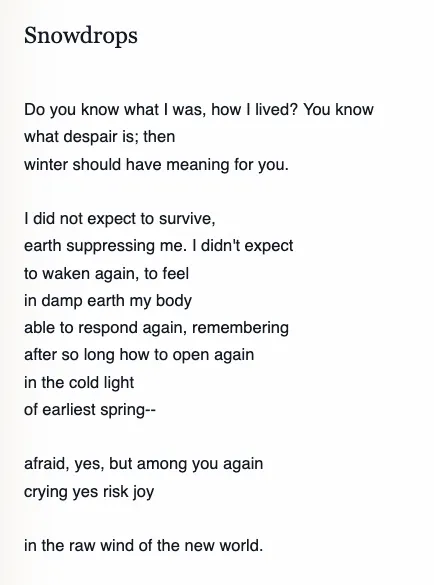
- I also read Louise Glück’s The Wild Iris. I’ll leave you with my favorite poem from it.